
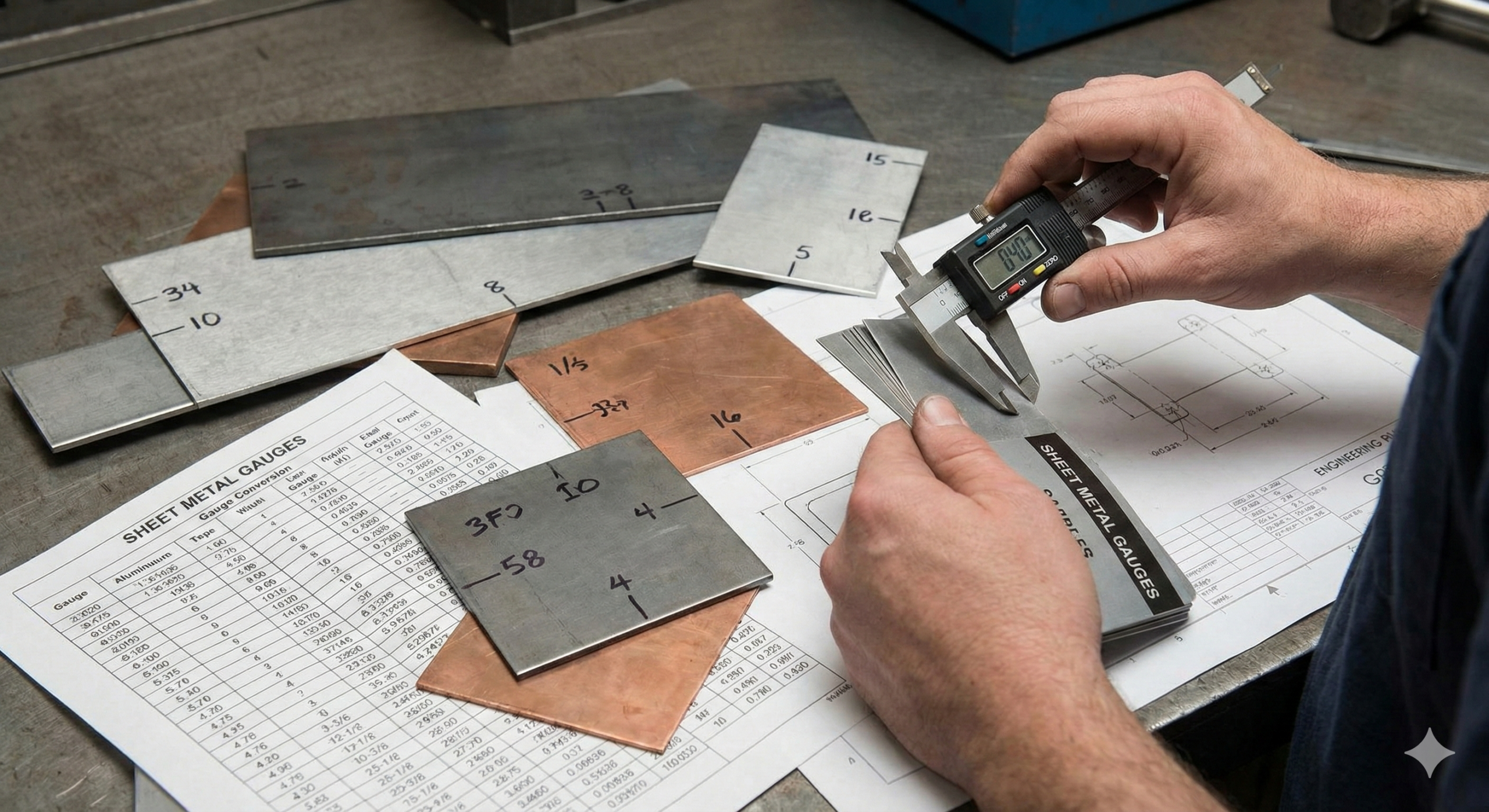
Selecting the wrong sheet metal thickness can quietly derail a project. Parts that flex when they should stay rigid. Assemblies that weigh more than they need to. Budgets that balloon because you specified heavier material than the application required.
The tricky part is that gauge selection involves tradeoffs that aren’t always obvious from a spec sheet. Thicker isn’t always better. Thinner isn’t always cheaper. And the “right” answer depends on factors like how the part will be formed, what loads it will carry, and how it fits into the larger assembly.
Imagine approaching your next design with clarity — knowing exactly which gauge gives you the strength you need without overbuilding, the formability your bends require, and the cost efficiency your budget demands.
That’s what this guide delivers. We’ll walk through the key factors that drive gauge selection, from mechanical requirements to manufacturing considerations, so you can make confident decisions before your design ever hits the shop floor.
1. Understanding sheet metal gauge basics
Sheet metal gauge is a standardized numbering system that indicates material thickness — but the system can feel counterintuitive at first. Lower gauge numbers actually mean thicker material, while higher numbers indicate thinner sheets. A 10-gauge steel sheet measures about 0.135 inches thick, while 18-gauge comes in at roughly 0.048 inches. This inverse relationship trips up even experienced engineers who are accustomed to measurement systems where bigger numbers mean more.
Adding another layer of complexity, gauge measurements vary between materials. A 16-gauge steel sheet isn’t the same thickness as 16-gauge aluminum or stainless steel. Each material type follows its own gauge chart, which means assumptions that work for one metal can lead to specification errors when applied to another.
These nuances matter because miscommunication around gauge creates costly mistakes. A designer who assumes gauge numbers work like standard measurements might accidentally spec material that’s far too thin for the application. Or a purchasing team might order the wrong thickness because they didn’t account for material-specific differences.
The simplest way to avoid confusion is to reference a gauge-to-inches conversion chart specific to your material type. When communicating with fabricators or across teams, consider specifying thickness in decimal inches alongside gauge numbers. This small habit eliminates ambiguity and ensures everyone — from design through production — is working from the same specifications.
2. How load and structural requirements drive gauge selection
The primary function of most sheet metal parts is to withstand specific forces. Whether the part supports weight, resists impact, handles pressure, or maintains rigidity under vibration, understanding the loads it will experience is the starting point for gauge selection. Every application places different demands on the material, and matching gauge to those demands is fundamental to sound design.
Getting this balance wrong creates problems in both directions. Under-specifying gauge leads to parts that flex, deform, or fail in service — sometimes catastrophically, sometimes in subtle ways that erode product quality over time. Over-specifying creates unnecessary weight, higher material costs, and potential challenges in forming and assembly. Neither outcome serves the project well.
Consider a practical example: imagine designing an equipment mounting bracket that needs to support a 50-pound motor in an environment with moderate vibration. You’d start by calculating the load distribution across the bracket’s geometry, factoring in dynamic forces from the vibration rather than just static weight. You’d apply an appropriate safety margin based on the criticality of the application. Then you’d select a gauge that meets those requirements without excessive overkill that adds cost and weight.
Early conversations with your fabricator can strengthen this process. Experienced fabrication partners have seen how different gauges perform across a wide range of applications and can help validate your calculations with practical insight. Their input often catches issues that pure calculation might miss.
3. Formability: how gauge affects bending and shaping
Material thickness directly impacts how sheet metal behaves during forming operations. Thicker gauges require more force to bend, demand larger bend radii to avoid cracking, and call for more robust tooling. They’re also more prone to springback — the tendency of metal to partially return toward its original shape after bending, which can throw off final dimensions if not accounted for in tooling setup.
Thinner gauges form more easily and accommodate tighter bend radii, but they come with their own challenges. Lightweight material may lack the rigidity needed for certain geometries to hold their shape during handling, assembly, and use. Complex forms in thin material sometimes require additional reinforcement features like hems, ribs, or flanges to maintain structural integrity.
Ignoring these realities during design leads to manufacturing headaches. Specifying tight bend radii on heavy-gauge material may be physically impossible without cracking the material at the bend line. Conversely, a thin-gauge part with numerous bends might emerge from forming too flimsy to function as intended.
The practical approach is to work backward from your design’s geometry. Identify the tightest bend radius your part requires and verify that your chosen gauge can achieve it cleanly. Most fabricators follow minimum bend radius guidelines, typically expressed as a multiple of material thickness. If your design pushes those limits, you have two options: adjust the gauge to accommodate the geometry, or modify the bend radii to stay within manufacturable ranges for your preferred thickness.
4. Balancing weight against performance
Material weight increases proportionally with gauge thickness, and for many applications, this relationship drives critical design decisions. Handheld equipment, vehicle components, parts that require frequent repositioning, and products competing in weight-sensitive markets all demand careful attention to mass. Lighter gauges reduce material weight but require thoughtful engineering to maintain adequate strength.
Excess weight carries real consequences beyond the obvious. Heavier parts drive up shipping costs across the product lifecycle. They complicate installation and maintenance. In moving assemblies, added mass accelerates wear on bearings, motors, and support structures. And in competitive markets, products that feel heavy or cumbersome often lose ground to lighter alternatives — even when performance is otherwise comparable.
However, chasing weight savings without accounting for structural needs creates its own problems. A part that’s too thin for its application will underperform, potentially damaging the product’s reputation or creating safety concerns.
The solution lies in evaluating where weight actually matters in your specific application. For static installations anchored to a concrete floor, heavier gauge may be perfectly acceptable — even preferable for rigidity. For portable, mobile, or motion-driven applications, the calculus shifts. In these cases, explore whether a lighter gauge combined with strategic reinforcements can deliver required strength at lower weight. Formed ribs, flanges, gussets, and strategic bend patterns can all add rigidity without adding significant mass.
5. Cost factors beyond material price
Raw material cost is the most visible expense in gauge selection, but it’s far from the only one. Thickness affects fabrication costs in ways that don’t always appear on the initial quote but definitely show up in total project economics. Understanding these factors helps you optimize for true cost efficiency rather than false savings.
Thicker materials consume more tooling wear over time. They require higher-tonnage press brakes for bending operations, which can affect scheduling and availability. Laser cutting speeds decrease as thickness increases, adding cycle time to each part. Heavy-gauge material also demands more careful handling and fixturing throughout the fabrication process.
Thinner materials, while cheaper per sheet, sometimes require additional operations to achieve necessary rigidity. A part that could be made from a single piece of heavier material might need formed stiffening features, welded reinforcements, or multi-piece assembly when using lighter gauge. Those secondary operations add labor, time, and cost that can offset material savings.
The path to genuine cost efficiency runs through your fabricator’s expertise. When evaluating gauge options, ask how thickness affects their processing. How does gauge impact cutting speed on their equipment? Does it change brake setup complexity or tooling requirements? Are there secondary operations that would offset material savings? A quick conversation early in design often reveals the most cost-effective approach — which may not be the option with the lowest material price.
6. Matching gauge to common applications
While every project has unique requirements, different applications tend to cluster around predictable gauge ranges based on their typical demands. Understanding these common starting points helps you sanity-check specifications and quickly identify when an unusual choice deserves closer scrutiny.
Electrical enclosures and control panels often land in the 16- to 18-gauge range for steel construction. This provides a workable balance of rigidity for mounting internal components, durability for industrial environments, and reasonable weight for wall mounting or floor installation. Structural brackets, frames, and load-bearing components typically call for heavier material — 10- to 14-gauge — depending on the loads involved. Decorative panels, covers, and access doors can often use thinner material in the 20-gauge range or above, since their primary function is protection and appearance rather than structural support.
Consider a designer specifying material for a control panel enclosure. The enclosure needs to be rigid enough to support mounted components without flexing, durable enough to handle occasional impact in an industrial setting, and light enough for practical wall mounting. Starting with 16-gauge steel as a baseline makes sense. From there, the designer evaluates whether the specific dimensions and mounting configuration require stepping up to 14-gauge for added rigidity — or whether strategic bends, flanges, and mounting reinforcements might allow stepping down to 18-gauge for weight and cost savings without sacrificing performance.
7. Get expert guidance for your next project
Gauge selection sits at the intersection of multiple variables — strength, formability, weight, cost — that interact in ways that aren’t always obvious on paper. The theoretical best choice and the practical best choice don’t always align, and the gap between them often only becomes visible through fabrication experience.
This is where early collaboration with your fabrication partner pays dividends. A shop that’s formed, cut, and welded thousands of parts across diverse applications brings pattern recognition that supplements engineering calculation. They’ve seen how different gauges behave on real equipment, what tolerances are consistently achievable, and where small design adjustments unlock meaningful improvements in manufacturability or cost.
The earlier this collaboration happens, the more value it delivers. Catching a gauge mismatch during design costs nothing to fix. Discovering it after tooling is built or production has started creates expensive delays and rework. A quick conversation about requirements, constraints, and options at the front end of a project can prevent headaches at the back end.
The EMS engineering team is available to discuss your project requirements and provide input on gauge selection and related design decisions. Whether you’re in early concept development or refining a design for production, we can help you navigate the tradeoffs and identify the approach that best serves your goals. Reach out at https://engineeredmechanicalsystems.com/contact/ to start the conversation.

Jim Anderson
Engineered Mechanical Systems
Dedicated to precision, quality, and building lasting relationships through expert fabrication and machining since 1990.