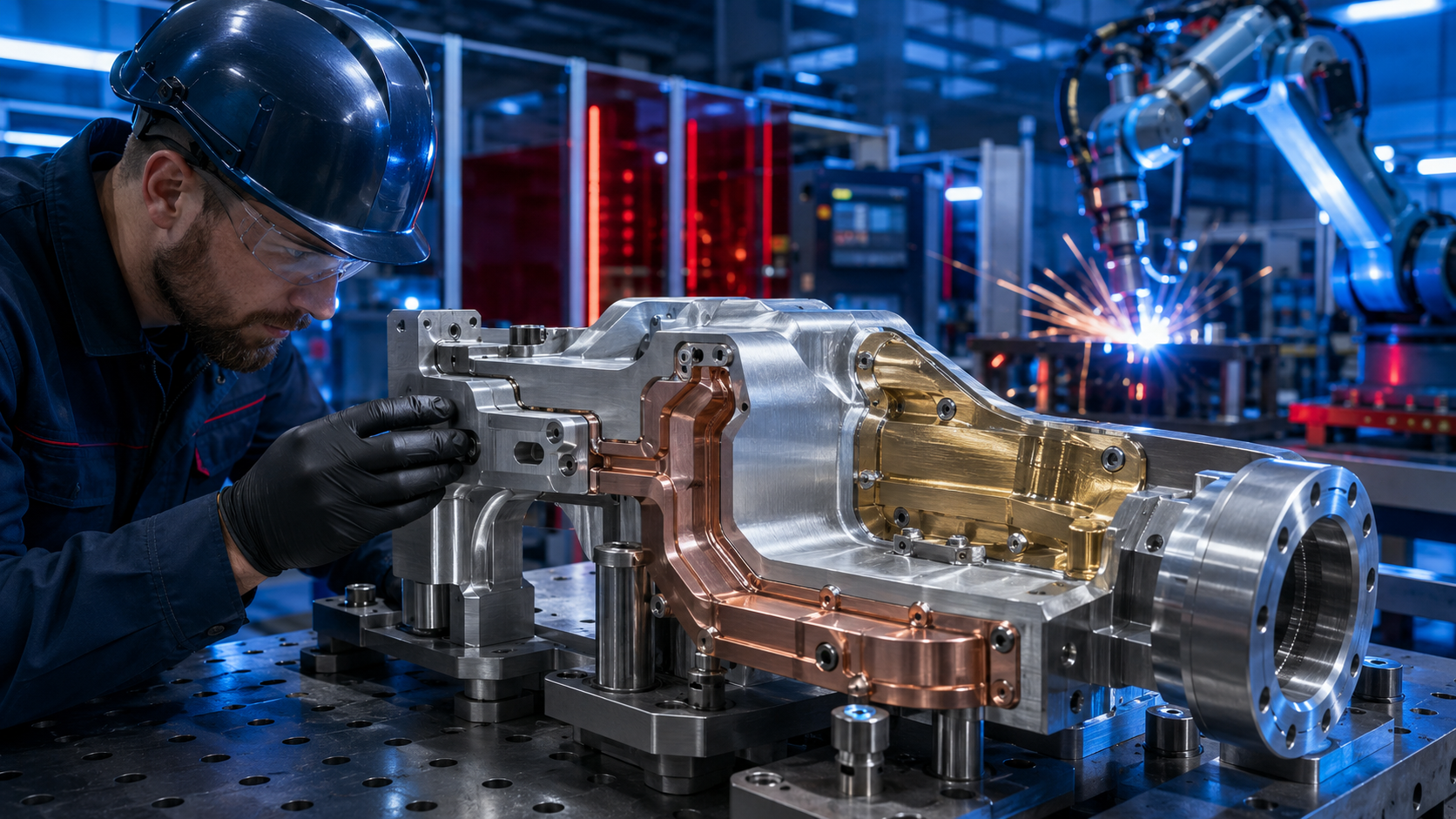
Multi-Material Manufacturing: Combining Metals for Superior Performance

Single-material designs often force engineers to compromise between conflicting requirements like strength versus weight, conductivity versus corrosion resistance, or cost versus performance. Multi-material approaches enable optimization of different component sections for specific requirements while maintaining overall system performance.

Traditional manufacturing methods limited multi-material applications due to joining challenges, material compatibility issues, and fabrication complexity. Modern fabrication techniques have expanded possibilities for combining dissimilar metals in single components through advanced welding, mechanical joining, and hybrid manufacturing processes.

Multi-material designs require careful consideration of thermal expansion differences, galvanic corrosion potential, and interface stress concentrations that don’t exist in single-material components. These factors affect both design approach and manufacturing method selection for successful implementation.

Companies implementing multi-material strategies typically achieve 15-25% weight reductions, 20-30% performance improvements, or 10-20% cost savings compared to single-material alternatives. Success requires systematic material selection and joining process optimization that addresses both performance and manufacturing requirements.

This comprehensive guide explains how to identify multi-material opportunities, select compatible material combinations, and implement fabrication processes that deliver superior performance through strategic material optimization.

1. Identify opportunities for multi-material optimization

Multi-material designs excel when different component sections require conflicting material properties that cannot be optimized simultaneously in single materials. Common applications include strength-critical sections requiring high-strength materials combined with corrosion-resistant surfaces or conductive elements.

Systematic analysis of component requirements reveals optimization opportunities where different materials could improve overall performance. Load-bearing sections may benefit from high-strength steels while external surfaces require corrosion resistance from stainless alloys or aluminum.

Map component requirements including mechanical loads, environmental exposure, electrical conductivity, thermal management, and cost constraints for different sections. Identify areas where single-material compromises limit performance and evaluate whether multi-material approaches could provide benefits that justify additional fabrication complexity.

2. Select compatible material combinations

Material compatibility affects both fabrication success and long-term performance through thermal expansion matching, galvanic corrosion resistance, and metallurgical compatibility. Incompatible materials may create manufacturing difficulties or premature failure through interface problems.

Thermal expansion differences create interface stresses during temperature changes that can cause failure if not properly managed. Galvanic corrosion occurs when dissimilar metals contact in corrosive environments, potentially causing rapid degradation. Metallurgical incompatibility may prevent proper bonding or create brittle interface compounds.

Evaluate thermal expansion coefficients, galvanic series positions, and metallurgical compatibility for candidate material combinations. Consider operating temperature ranges and environmental exposure conditions that affect material selection. Use compatibility matrices and joining process capabilities to guide material selection decisions.

3. Design interfaces for stress management and load transfer

Interface design significantly affects multi-material component performance because stress concentrations and load transfer mechanisms differ from single-material designs. Proper interface geometry and joining methods ensure reliable load transfer while managing stress concentrations.

Abrupt material transitions create stress concentrations that may cause premature failure under load. Gradual transitions, mechanical interlocks, and proper joint design distribute stresses more effectively while maintaining load transfer capability.

Design interface geometries that provide smooth load transitions between different materials. Use mechanical fasteners, welded joints, or brazed connections appropriate for material combinations and loading conditions. Consider stress concentration factors and design safety margins that account for interface effects on component strength.

4. Implement advanced joining techniques for dissimilar metals

Joining dissimilar metals requires specialized techniques that accommodate different melting points, thermal conductivities, and chemical compositions. Advanced welding processes, brazing techniques, and mechanical fastening methods enable reliable joints between incompatible materials.

Friction stir welding, laser welding, and electron beam welding provide precise heat control that enables joining of dissimilar metals without excessive heat affected zones. Brazing and soldering use intermediate alloys that bond to both base materials. Mechanical fastening avoids metallurgical compatibility issues entirely.

Select joining processes appropriate for specific material combinations and performance requirements. Consider joint strength, environmental resistance, and temperature capability needed for application requirements. Validate joining process parameters through testing and qualify procedures for production implementation.

5. Manage thermal expansion and interface stresses

Thermal expansion differences between dissimilar metals create interface stresses during temperature changes that can cause failure if not properly managed. Design approaches must accommodate expansion differences while maintaining structural integrity and joint reliability.

Interface stress management techniques include flexible joint designs, stress relief features, and material selection that minimizes expansion differences. Thermal barrier layers or gradual composition transitions can reduce stress concentrations at material interfaces.

Calculate thermal stress levels for operating temperature ranges and design interfaces that accommodate expansion differences without failure. Use finite element analysis to evaluate stress distributions and optimize interface geometries. Consider thermal cycling effects on joint fatigue life and design appropriate safety factors.

6. Prevent galvanic corrosion in multi-material assemblies

Galvanic corrosion accelerates when dissimilar metals contact in corrosive environments, potentially causing rapid degradation of more reactive materials. Prevention strategies include material selection, protective coatings, and design approaches that eliminate galvanic couples.

Galvanic corrosion rates depend on material potential differences, area ratios, and environmental conditions. Large cathode areas coupled with small anode areas create severe corrosion conditions that require careful design consideration.

Evaluate galvanic compatibility for material combinations in expected service environments. Use protective coatings, insulating barriers, or cathodic protection systems where necessary. Design area ratios and environmental exposure to minimize galvanic corrosion risks. Consider maintenance requirements for protective systems over component service life.

7. Optimize manufacturing sequences for multi-material components

Multi-material manufacturing requires careful process sequencing that accommodates different material properties, joining requirements, and heat treatment considerations. Manufacturing sequence affects both quality and cost through material handling, fixturing, and processing efficiency.

Heat treatment requirements may differ between materials, requiring selective heating or protective atmospheres. Machining sequences must account for different material properties and potential work hardening effects. Assembly procedures must ensure proper fit-up and joint quality between dissimilar materials.

Develop manufacturing sequences that optimize quality, efficiency, and cost for multi-material components. Consider material property differences in machining, forming, and heat treatment operations. Design fixturing and handling systems that accommodate different material requirements while maintaining dimensional accuracy.

8. Partner with multi-material fabrication specialists

Successful multi-material manufacturing requires expertise in material compatibility, joining processes, and manufacturing optimization that most engineering teams lack internally. Experienced fabrication partners provide knowledge and capabilities that enable successful multi-material implementation.

Multi-material specialists understand compatibility issues, joining process selection, and manufacturing optimization that determine project success. They provide testing capabilities, process development, and production support that enables reliable multi-material component manufacturing.

Contact EMS to discuss multi-material fabrication capabilities that optimize component performance through strategic material selection and advanced joining processes. Our expertise in dissimilar metal joining, stress analysis, and manufacturing optimization enables multi-material solutions that deliver superior performance while meeting cost and delivery requirements.

>